
RHEO AI Smart Operational Platform helps major industrial manufacturers reduce labor cost while simultaneously improving customer service levels
- ABSTRACT
A division of one of the top residential Windows and Doors manufacturing conglomerate was experiencing increasing Labor Costs, while daily throughput remained flat and on-time Customer Service levels were deteriorating. To improve service levels and reduce labor cost, the business needed to quickly understand the primary factors impacting performance of the glass cut process and the specific improvements required to improve performance rapidly.


THE OVERVIEW
- Labor costs were increasing, and on-time customer delivery was declining due to the extremely complex interactions of production scheduling, employee turnover, labor rate increases, and equipment unplanned downtime.
- Management relied on tribal knowledge and experience to drive process improvements.
SCENARIO
In a Windows and Doors manufacturing business, the glass cut process is critical, as it provides glass to the insulated glass (IG) assembly lines, which are then mounted on frames to produce windows.
If the glass cut line does not produce the required demand, it negatively impacts the daily capacity of multiple automatic and manual IG assembly lines. Also, as a result of unplanned equipment downtime, and high employee turnover, the business was experiencing insufficient demand fulfillment.
If the glass cut line does not produce the required demand, it negatively impacts the daily capacity of multiple automatic and manual IG assembly lines. Also, as a result of unplanned equipment downtime, and high employee turnover, the business was experiencing insufficient demand fulfillment.
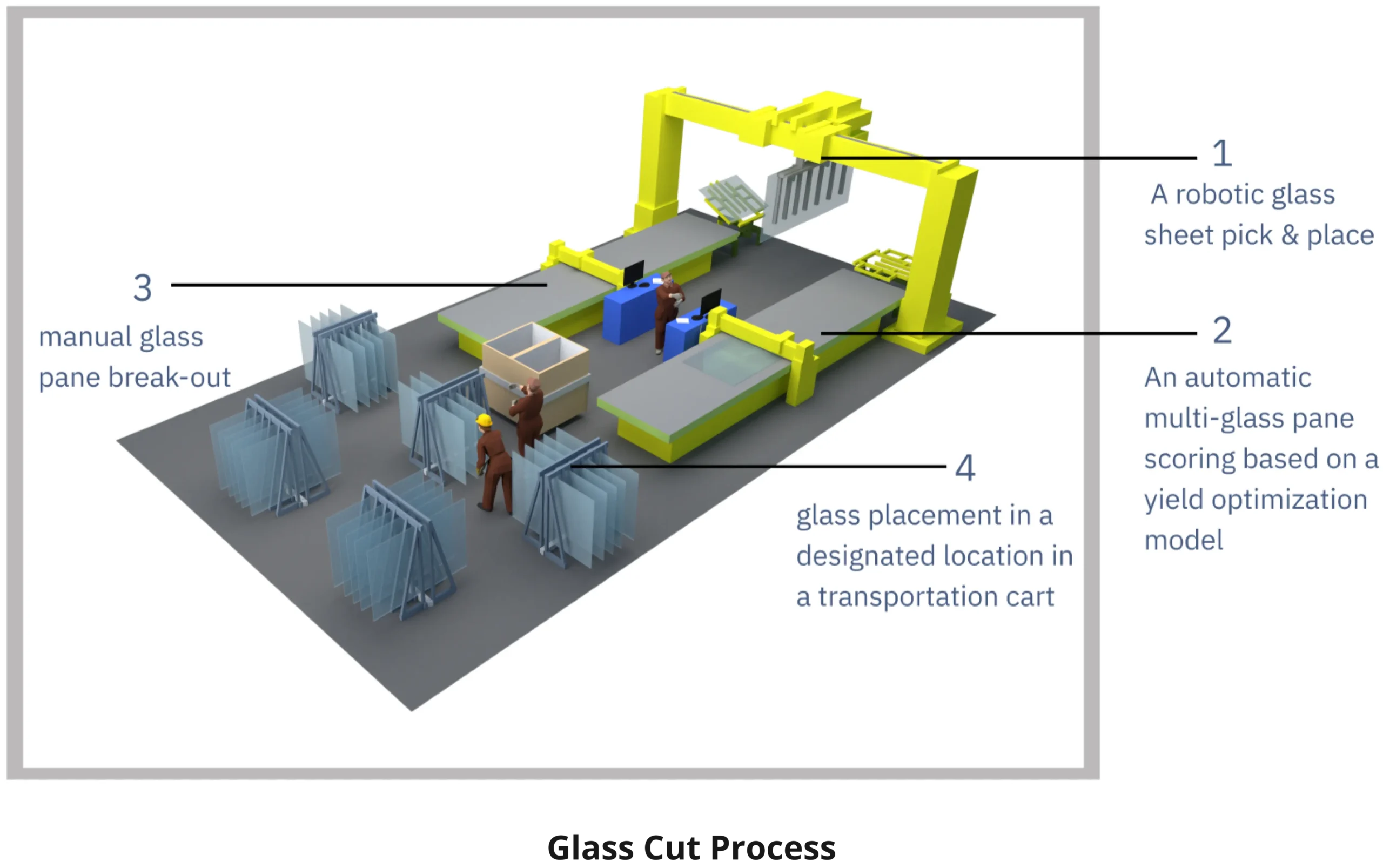
The glass cut process consists of :
1. A robotic glass sheet pick & place
2. An automatic multi-glass pane scoring based on a yield optimization model
3. Manual glass pane break-out
4. Glass placement in a designated location in a transportation cart.
2. An automatic multi-glass pane scoring based on a yield optimization model
3. Manual glass pane break-out
4. Glass placement in a designated location in a transportation cart.
THE CHALLENGE
- Complex multi-variant process difficult to optimize using traditional improvement tools and techniques
- Translate qualitative opinions to quantitative facts and data
Data related to equipment downtime was readily available, but the business did not know the downtime root causes. Also, the process optimization complexity is amplified by mixed model batch production scheduling which include variations in glass cut size, thickness, and grade coupled with varying seasonal demand cycles. Optimizing these types of multi-variate processes are extremely complicated to do with traditional cycle time and takt time analysis.
THE SOLUTION
- Translated complex multi-variate process performance data to simple process improvement insights empowered process owners to manage, hypothesize and drive improvements
RHEO AI Smart Operational Platform was deployed to automate data collection, analysis and process visualization using cameras and sensors. The RHEO platform's integrated intelligence capabilities enabled the process managers, supervisors, leads, and line operators to quantify inefficiencies, in addition to automatically providing real-time identification and prioritization of root causes impacting process performance. This, in-turn, facilitated quick decisions on the actions required to improve performance.
THE RESULTS
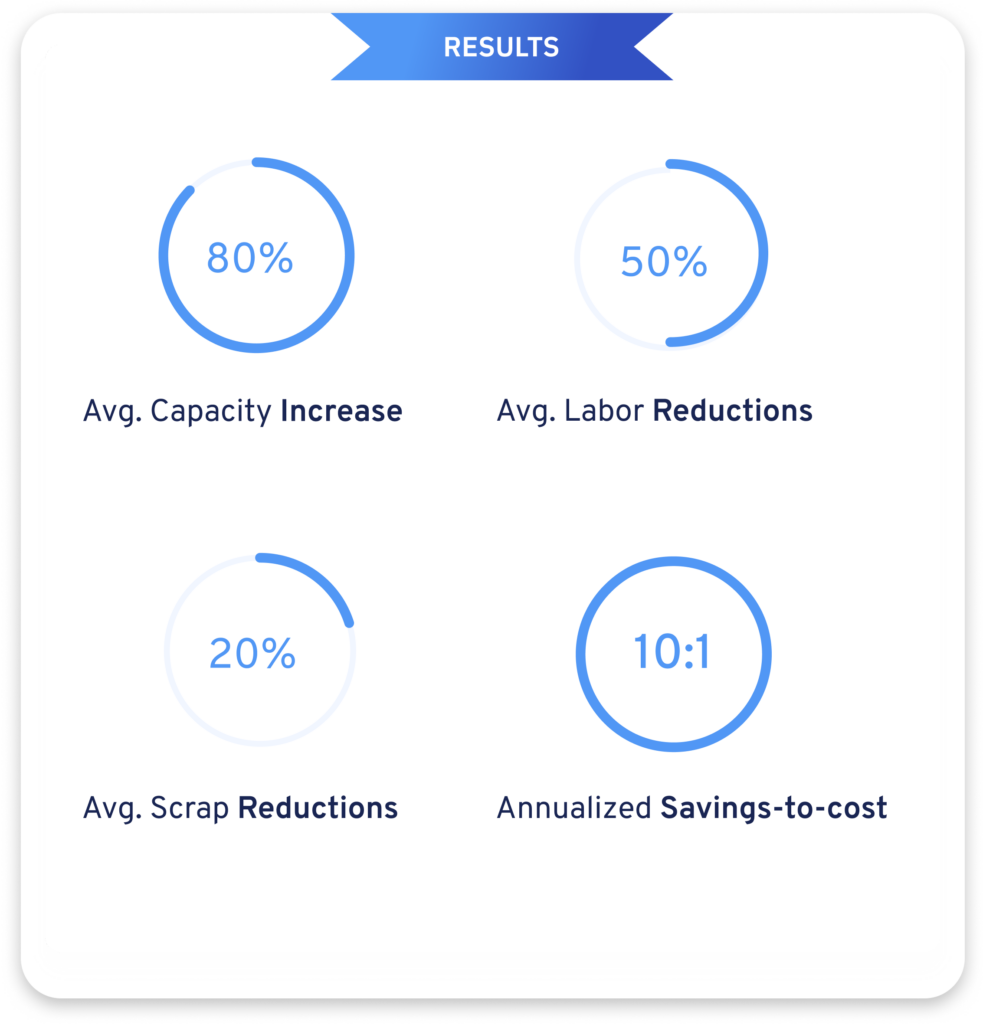
- The RHEO system identified EBITDA labor savings (including Overtime) of over Six Figures in the first two weeks of introducing the RHEO system. The manufacturer is currently deploying the RHEO system for the glass-cutting process across several of their plants.